f
|
|
|
Historic & Literary Associations
with the Blennerhassett Family
contributed by Leslie Eric Blennerhassett M.A. (TCD)
for those who enjoy literature, finding diverse historic,
literary or artistic associations with a family name
in which one is interested can be very rewarding...
|
|
| |
|
|
|
|
|
|
|
|
|
|
|
|
|
Field Marshal Henry Seymour Conway
1721-1795
portrait by Samuel William Reynolds,
after Sir Joshua Reynolds.
mezzotint print of 1820.
copyright © National Portrait Gallery D1552 |
Harman Blennerhassett (1764-1831) of Castle Conway, Killorglin, Co.Kerry and later of Blennerhassett Island in the Ohio River, West Virginia, USA was son of Capt. Conway Blennerhassett Jr (1720-1792) and grandson of Conway Blennerhassett Sr (born 1693), each named for their forbear, Captain Jenkin Conway of Castle Conway.
Jenkin Conway was, with Sir Edward Denny of Tralee, one of the original Undertakers or Planters in the Plantation of Munster, those who came to Co.Kerry at the end of the 16th Century to settle on lands forfeited to the crown by the rebel Earl, Sir Gerald FitzGerald, 15th Earl of Desmond.
Jenkin Conway was granted the lordship of Killorglin, later called Castle Conway. His daughter Elizabeth Conway subsequently married Robert Blennerhassett of Flimby, Cumberland, Robert being an undertaker who came to Kerry in 1590 as a plantation candidate of Sir Edward Denny. From his own grant of 12,000 acres in Tralee and vicinity Edward Denny had granted to Thomas Blennerhassett, father of Robert, the lands of Ballycarty & Ballyseedy, but it was Robert Blennerhassett not Thomas who settled there.
Robert Blennerhassett's grandson, also named Robert (known as "Captain Hassett") married c1662 to Avice Conway, daughter and co-heir of Edward Conway of Castle Conway and grand-daughter of Jenkin Conway. By this marriage Robert acquired for himself most of the Killorglin estate originally granted to Jenkin Conway in 1587.
The Irish Conways were cousins of the Welsh Conways, whose seat was the magnificent Conway or "Conwy" Castle in North Wales. Built for Edward I by "Master James of St George", the castle is amongst the finest surviving medieval fortifications in Britain.
One of the Welsh Conway family acquired Ragley Hall in Warwickshire, the Seymour Conway surname coming into being when the Seymour family, through a Conway heiress, inherited Ragley. The Seymours had been heirs of the attainted Duke of Somerset, brother of Jane Seymour, one of the six wives of King Henry VIII. The Kerry branch of the Blennerhassetts shared their common Conway ancestry, as did Daniel O'Connell "The Liberator".
The Seymour Conways held the titles Marquess of Hertford and Baron Conway. The 1st Marquess was Francis Seymour Conway, Viceroy of Ireland in 1793 and later British Ambassador to France. His brother Field Marshal Henry Seymour Conway (1721–1795) was a distinguished general and statesman, commencing his military career during the War of the Austrian Succession and rising to be Commander-in-Chief of the British Forces.
He employed as his secretary the philosopher David Hume (1711-1776), acknowledged as one of the great thinkers of his age and considered the most sophisticated Scot of the enlightenment. Henry Seymour Conway enabled the French writer Rousseau, exiled in England, to draw a British government pension, doing this without obtaining the approval of King George III.
A cousin and close friend of Henry Seymour Conway was Horace Walpole 4th Earl of Orford (1717-1797), a son of Sir Robert Walpole (1st Earl of Orford, British Prime Minister and cousin of Horatio Nelson ). Whig politican, art historian, antiquarian and man of letters, Horace Walpole is remembered for Strawberry Hill, the fascinating house he built at Twickenham, reviving the gothic style some decades before the Victorians; for his gothic novel " The Castle of Otranto"; and for his " Letters", which are of significant social and political interest.
Henry Seymour Conway was stepfather-in-law to Charles Lennox, later to succeed to the family title as 3rd Duke of Richmond. The Lennox family were imbued by French culture and conversant with the intellectuals of the French Enlightenment, namely Voltaire, Rousseau and not least the empiricist philosophy expounded by David Hume, John Locke and George Berkele y. Harman Blennerhassett while attending Westminster School was school-mate of Charles Lennox, nephew and heir of the 3rd Duke of Richmond, they forming a life-long friendship. This Charles Lennox would later become 4th Duke of Richmond. Emily Lennox, the 3rd Duke's sister, married the Duke of Leinster and was mother of Lord Edward Fitzgerald . |
|
|
|
|
|
|
|
Sources:
(1) "Selections from Old Kerry Records, Historical and Genealogical" by Mary Agnes Hickson, vol.1 1872, vol.2 1874. |
|
|
|
|
|
|
|
CHARLES LENNOX, 4th Duke of Richmond |
|
|
|
|
|
|
Charles Lennox, KG, PC,
4th Duke of Richmond
1764-1819
Lord Lieutenant of Ireland
Governor-General of Upper Canada
portrait by Henry Collen 1823
after an original by
Henry Hoppner Meyer
| Harman Blennerhassett's friend Charles Lennox in 1806 succeeded as 4th Duke of Richmond, and as such he substantively inherited the courtesy title Earl of March ( of the 4th creation).
NOTE: coincidentally Harman Blennerhassett of Conway Castle, together with all descendants of John Blennerhassett of Ballycarty & Ballyseedy, could through his wife Martha Lynn claim descent from Roger Mortimer, 4th Earl of March (of the 1st creation). That title became defunct during the 15th century.
Roger Mortimer, 4th Earl of March and 6th Earl of Ulster (b.1374 d.1398), as great-grandson of Plantagenet King Edward III, was between 1385 and 1398 the heir presumptive to Richard II of England. Mortimer was son of the powerful Edmund Mortimer, 3rd Earl of March, and his wife Philippa, sole issue of Lionel of Antwerp (the Duke of Clarence, 2nd surviving son of King Edward III of England and Philippa of Hainault).
Richard II in 1399 was deposed by his rival half-brother, King Henry IV. Roger Mortimer's brother-in-law Henry Percy, known as Harry Hotspur (another ancestor of the Blennerhassetts through Martha Lynn) rebelled against Henry IV and was killed at the Battle of Shrewsbury in 1403. The fiery Hotspur is dramatised in William Shakespeare's plays "Richard II" and "Henry IV".
Charles Lennox was a talented sportsman and sponsor of the first and pre-eminent English cricket club, the Marlebone Cricket Club (MCC). It was said "that as an officer he made himself very popular with his regiment by playing cricket with common soldiers, and was one of the finest formed men in England, and his playing of cricket was praised for his equisite display of grace, strength and skill". Cricket was first officially played at Hambledon, Sussex (not to be confused with Hambledon, Hampshire, where Harman Blennerhassett was born... !). The annual cricket match held at Goodwood House, ancestral home of the Richmond family, is a classic venue to which international teams are invited.
Lennox was aide-de-camp to King George III, as had been General James Agnew (grandfather of Margaret Agnew, wife of Harman Blennerhassett). General Agnew was killed at the battle of Germanstown in 1777, during the American War of Independence.
NOTE: Politically the 4th Duke was not as innovative as his uncle, the 3rd Duke, who was remembered as a champion of the American Colonists before and during the War of Independence, proponent of universal male suffrage (a 150 years ahead of its time) and defender of the liberties of Irishmen.
In 1807 Lennox was Lord Lieutenant of Ireland 1806-1813, with Arthur Wellesley (later 1st Duke of Wellington) as his secretary. Harman Blennerhassett was distantly related to Wellesley, his maternal grandmother being Arthur Wellesley's grand-aunt.
Charles was a part of the military command prior to the Battle of Waterloo in 1815, as was (of course) his friend and protegee Arthur Wellesley, later Duke of Wellington. On the 15th June 1815 Charles, with his wife the Duchess, hosted at their home in Brussels the now-famous "Duchess of Richmond's Ball" for Wellesley and his officers. Events leading up the Ball are described by W.H. Thackeray in his novel "Vanity Fair", and immortalised by Lord Byron's poem The Eve of Waterloo, a part of his longer work "Childe Harold's Pilgrimage". The poem relates the events of the night before the battle of Quatre Bras, fought near Brussels on 16th June 1815, preliminary to the battle of Waterloo fought two days later. This is the first verse...
|
|
There was a sound of revelry by night,
And Belgium's capital had gathered then
Her beauty and her chivalry, and bright
The lamps shone o'er fair women and brave men.
A thousand hearts beat happily; and when
Music arose with its voluptuous swell,
Soft eyes looked love to eyes which spake again,
And all went merry as a marriage bell;
But hush! hark! a deep sound strikes like a rising knell! |
|
Allegedly, the ball was held on the eve of Waterloo to mislead Napoleon Bonaparte about allied intentions; as officers disported at the ball, news arrived of Bonaparte's advance on Brussels. Quatre Bras followed; then Waterloo, where Prussian troops under Blücher arrived in support of Wellington and Bonaparte was defeated.
A Westminster school colleague, with whom Harman would later correspond, was Henry William Paget, Earl of Uxbridge, later Marquess of Anglesey and Wellington's brother-in-law. Paget, the brilliant commander of cavalary at Waterloo, was by Wellington's side when in the heat of the battle he lost his leg from grapeshot fire, famously calling to Wellington " By God, sir, I've lost my leg!", to which Wellington replied " By God, sir, so you have!". Paget survived the amputation, the leg being encased in a monument erected at the field of Waterloo, but the bones were later disinterred and put on display.
Lieutenant Aldworth Blennerhassett, a distant cousin of Harman, fought at both Quatre Bras and Waterloo with the 2nd Battalion, 73rd Infantry Regiment, in Capt. J. Garland's Company. He was then aged not more than 19 years, having joined the regiment as an Ensign (without purchase) in 1814, promoted Lieutenant (again, without purchase) in 1815. It is conceivable that Aldworth was present at the famous ball.
Aldworth was later to serve at Van Diemen's Land (now Tasmania) & New South Wales; at Ceylon (now Sri Lanka) 1818-1821, being present during the Kandy insurrection of 1818-19; and in the Ava campaign at Burma, 1825. He joined the 38th Infantry Regiment in 1823 as Lieutenant, promoted Captain 1834. He married Lucy Anne Douglas but they left no descendants.
Towards the end of his soujourn in the United States, Harman Blennerhassett's financial plight became severe. Charles Lennox, 4th Duke of Richmond rersponded as a friend should, offering to support Harman in seeking an appointment as judge in Upper Canada (now Ontario), where in 1818 the Duke had been appointed Governor General. Harman responded by moving to Canada but, unfortunately for him, the expected support for his application was not to be forthcoming.
The Duke visited Upper Canada in 1819, touring the province. He died there on 28th August 1819, of rabies, said to have been infected when bitten by a pet fox, although local legend tells a variation of the story, that a fox bit the Duke's dog, the infected dog in turn biting the Duke. Whichever is true, the village of Richmond has, as it's mascot, a fox.
Charles Lennox spent the night before he died at the "Masonic Arms" a tavern in the village of Richmond, near Ottawa in eastern Ontario (not to be confused with Richmond Hill, near Toronto in southern Ontario, a village named for him after he had stopped there during his 1819 visit).
Maria Hill, wife of Andrew Hill the tavern owner, prepared his body to be sent to Quebec City for burial; the "Masonic Arms" was subsequently renamed "Duke of Richmond Arms" to commemorate the tragic visit. The Duke was given a state funeral, buried under the alter in the Anglican Holy Trinity Cathedral (Cathédrale anglicane Holy Trinity) at Quebec City. It was observed that the 4th Duke's place of birth and death had similarities. It was said that his pregnant mother Lady Louise (nee Kerr) went into labour during a fishing party, there being time only to carry her to a neighbouring farm yard, where the Duke was born. His death was followed by a report that "the Duke seems to have died, just as he was born, in a barn". |
|
|
|
|
|
|
|
Sources:
(1) "Aristocrats" by Stella Tilyard, 1999.
(2) "Goodwood Oaks" by M.M. Reese, 1987 (this volume concerns the 3rd and 4th Duke of Richmond).
(3) "Childe Harold's Pilgrimage", narrative poem by Lord Byron, published 1812-18 |
|
|
|
|
|
|
|
THE WALLACE COLLECTION |
|
|
|
|
|
Sir Richard Wallace, 1st Baronet
1818-1890
philantropist and art collector |
I have an interesting anecdote relating to the Hertford family. My godson's ancestor Robert Symonds was commissioned to paint a portrait of Sir Richard Wallace (1818-1890), natural son of Richard Seymour Conway, 4th Marquess of Hertford, of Ragley Hall. His mother was Agnes Jackson, about whom little is known.
Sir Richard and Lady Wallace are remembered in Britain and France as one of the great philanthrophic families of the Victorian era. While living in Paris during the siege of 1877 Richard Wallace performed many acts of charity, personally equipping two ambulances, founding a hospital and contributing approximately 2.5 million francs to the needy of the city. The last balloon to leave Paris before its capitulation was named for him, as was a Paris boulevard, and he was awarded the Legion d'Honneur.
In contrast, Sir Richard Wallace's paternal grandfather Francis Charles, the 3rd Marquess, led a somewhat wayward existence - the Prince Regent, later King George IV, perhaps setting that trend. When the 3rd Marquess' unconventional mother, Lady Hertford, was asked about her replacement by Lady Conyngham as the King's favourite, the stately Marchioness replied: "Intimately as I have known the King, he has never ventured to talk to me about his mistresses". In deference to the more generous views of the present Hertford family, they do assert that the King was personal friend of both husband and wife. The hedonistic 3rd Marquess was later to be portrayed in literature; by Disraeli as "Lord Monmouth" in his novel "Coningsby" and by Thackeray as "Lord Steyne" in "Vanity Fair". Of him it was said "It would be charitable to assume an element of insanity in Hertford's later excesses".
On a more positive note, the 3rd Marquess was a true connoisseur, his art collections providing the core of what was to become his grandson's famed Wallace Collection. To complement his father's superlative acquisitions, the 4th Marquess made further purchases including French furniture, painting, objet d'art and medieval armour. The 4th Marquess never married. He bequeathed his unentailed estate, including the extensive collection of European art but excluding Ragley Hall and Conway Castle, to his natural son Sir Richard Wallace, who for the remainder of his life would continue to enhance the collection. The Wallace Art Collection was in 1897 bequeathed to the British nation by Sir Richard's widow, Lady Wallace. The collection is on public view at Hertford House, Sir Richard's London home, and the present Seymour Conways are rightly proud of their family legacy. It is well worth a visit, or two. |
|
|
|
|
|
|
|
Sources:
(1) .... <add here> |
|
|
|
|
|
|
|
SOCIETY OF UNITED IRISHMEN |
|
|
|
|

|
|
"THE UNITED IRISH PATRIOTS 1798"
eighteen figures including Wolfe Tone,
Lord Edward FitzGerald, Robert Emmet, etc.
coloured lithograph
"an attractive but historically inaccurate compilation"
|
The above-mentioned Lord Edward FitzGerald was a prominent member of the Dublin branch of The Society of United Irishmen, a secret society working towards self-government for Ireland, seeking to achieve this by uniting nationalist leaning Anglican, Presbyterian and Catholic into a single movement. Formed in 1791, their headquarters were at Belfast with a large branch at Dublin, and while it had a predominantly Protestant leadership & membership, it enjoyed considerable support from the Catholic middle class.
Their leader at the SUI Belfast HQ was Theobald Wolfe Tone, a young lawyer, with Lord Edward FitzGerald becoming de facto "commander of the military wing". A member of the Dublin branch was Thomas Addis Emmet (1764-1827), who like Lord Edward had spent considerable time in France and shared his republican philosophy. Harman Blennerhassett, friend and kinsman of Thomas Addis Emmet, also became a member of the Dublin branch, joining in 1793. He too had been influenced by revolutionary France, while undertaking the obligitory young gentleman's "grand-tour" of Europe, but c1795 had ceased to be an active member.
To the British government "the unabashed admiration of the United Irishmen for the French" of the seemed akin to treason, and the Dublin branch of United Irishmen was in 1794 suppressed by the police, causing the society to go underground when continued active membership became illegal (5). In 1796 the Belfast leadership were arrested on treason charges and gaoled, and subsequent to this any active member whose cover was blown was liable to be arrested. The United Irishmen continued their work in secret, planning two insurrections against the government, in 1798 and 1803, both of which failed. Shortly before the 1798 insurrection its members were exposed by a government spy, Thomas Collins, who later left Ireland to settle in Dominica, having been given naval officer rank and a pension.
Harman Blennerhassett avoided such harassment by the authorities, selling his Conway Castle estate (in doing so breaking the entail) to Thomas Mullins (later 1st Lord Ventry) on 27th October 1795, for £28,000. Six months later he sailed to the United States on the ship "Harriet", departing Gravesend near London on 20-May-1796, arriving at New York on 1-August-1796 after an exceptionally long voyage of 10,000 miles lasting 73 days, caused by alternatively being becalmed then blown off course. With him he carried the large amount of money gained from the sale of his inheritence, plus substantial supplies and equipment purchased in London, and a bride. Harman's new wife was a major motivation for his actions, it being a scandalous (and illegal) marriage to his niece Margaret Agnew (1771-1842). Their marriage is believed to have taken place secretly England, during the year immediately prior to their departure for America, but no marriage record has yet been found. Their marriage resulted in the couple being disowned by both families.
Two years later, on the eve of the 1798 rebellion, Theobald Wolfe Tone, Lord Edward FitzGerald and Thomas Addis Emmet were arrested, each in differing circumstances, and imprisoned. Wolfe Tone was court-marshalled and sentenced to death; before the sentence could be carried out he attempted suicide, initially failing but he later died of his wounds in prison. Lord Edward died in prison as a result of injuries received while resisting arrest. TAE was released in 1802, moving first to Brussels, Belgium, where in October of that year he was visited by his younger brother Robert Emmet, who informed him of preparations for a fresh uprising in Ireland to be made with French assistance. Unfortunately for them, at that stage France and Britain were (briefly) at peace and Napoleon Bonaparte turned down the Emmets' pleas for French assistance.
In July 1803 Thomas Addis Emmet was at Paris and in communication with Napoleon when he received news of the failure of the uprising led by his brother Robert. After Robert's trial and execution at Dublin, T.A.E. in 1804 emigrated to the USA with his wife and children, joined the New York Bar and established himself as a lawyer in New York City. He served as Attorney-General for the State of New York 1812-13. At New York he was host to Harman & Margaret Blennerhassett, he and his family helping them with legal and financial matters resulting from their loss of Blennerhassett Island and loss of fortune. |
|
|
|
|
|
|
|
Sources:
(1) "Citizen Lord: Edward Fitzgerald, 1763–1798" by Stella Tilyard, 1998.
(2) "Proceedings of the Dublin Society of the United Irishmen" by R.B. McDowell, 1998.
(3) "Companion to Irish history" by P.R. Newman, 1991. |
|
|
|
|
|
|
|
ROBERT EMMET |
|
|
|
|
|
Robert Emmet
1778-1803
this portrait is on loan to
Dublin's Georgian House Museum |
Following the arrest of Thomas Addis Emmet at the time of the 1798 insurrection, his younger brother Robert Emmet (1778-1803), known in Ireland as "The Patriot", picked up the torch from Wolfe Tone to lead in 1803 a second United Irishmen rebellion against British government in Ireland. This rebellion also failed, Emmet losing control of his followers, the not-unsympathetic Lord Chief Justice of Ireland being dragged from his carriage and hacked to death outside Dublin Castle. Robert was charged with high treason, tried and convicted, his telling speech at the dock concluding with "...when my country takes her place among the nations of the earth, then, and not till then, let my epitaph be written..." , a line that quickly entered nationalist Irish folklore.
Emmet was publicly hanged at Dublin, his body beheaded, the ancient and customary punishment for treason. A death mask was made, usual procedure following execution of a "notorious criminal", by Scottish-born Dublin artist James Petrie, on which mask Petrie later based his Portrait of Robert Emmet, believed painted for Emmet's grieving girlfriend Sarah Curran. Robert Emmet's death mask was at one time owned by Garland Emmet, descendant of Thomas Addis Emmet, but is now in the museum at Kilmainham Goal, Dublin. Emmet's headless body is known to have been buried nearby at Bully's Acre, then removed by friends to be reinterred elsewhere in Dublin, the location of his final resting place a subject of controversy ever since. Local tradition in Co.Kerry claims it was taken there from Dublin, to be reinterred under the back porch of Blennerville Church (since demolished) but this is almost certainly wishful thinking as evidence suggests his body remained at Dublin.
The Emmet family, strongly Church of Ireland, were kinsmen of the Roman Catholic O'Connells, and it is interesting to contrast the achievements of Daniel O'Connell's peaceful methods of protest with those of the United Irishmen and their martyred heroes Wolf Tone and Robert Emmet. Irish historian Edward Alfred D'Alton in 1910 wrote of Robert Emmet: "On the whitewashed walls of every Irish peasant's home, beside the picture of the Pope and of O'Connell, there is another that is familiar to us all. It is that of Emmet... wherever the Irish race has gone it is the same, and abroad or at home, the name of Emmet is one with which to conjure... to erect a monument which is still unthought of and to write that epitaph which is still unwritten".
Petrie's Portrait of Robert Emmet, painted postumously from Emmet's death mask, is displayed on loan at Number Twenty Nine, Dublin's excellent "Georgian House Museum" on FitzWilliam Street Lower, managed by the National Museum of Ireland. The first occupants of the house, in November 1794, were Mrs Olivia Maria Beatty, widow of David Beatty, and their children, one of whom, also named David Beatty, is ancestor of Admiral Earl Beatty. |
|
|
|
|
|
|
|
|
|
|
|
|
|
|
|
TALBOT CLIFTON |
|
|
|
|
|
|
Talbot Clifton 1868-1928
portrait by <???>
at Lytham Hall,
courtesy of Lytham Estate Office
image from:
"West Lancashire Evening Gazettte"
(now "Blackpool Gazette")
| (John) Talbot Clifton (1868-1928), squire of Lytham, Co.Lancashire, was a descendent of Susan Blennerhassett, sister of Harman Blennerhassett of "Blennerhassett Island" , through his mother Madeline Agnew, daughter of Sir Andrew Noel Agnew 9th Baronet of Lochnaw.
Talbot Clifton led an adventurous life, travelling to North & South America, Russia, Africa, India and the Far East. During his first visit to the United States, in 1890, he had a lengthy affair with Lillie Langtry (1853-1929). He features in "As I Was Going Down Sackville Street", a classic memoir from the golden age of Dublin and autobiography of his close friend Oliver St John Gogarty (1878-1957), surgeon, writer and member of the first Irish Senate.
Sackville Street, Dublin was in 1924 renamed O'Connell Street, to honour "The Liberator" Daniel O'Connell (1775-1847) whose statue has stood in the centre of the street near O'Connell Bridge since 1882, and whose wife Mary O'Connell was granddaughter of Jane Blennerhassett and Maurice O'Connell of Waterville, Co.Kerry.
Aged 39 years he married Violet Mary Beauclerk, whom he met in Peru. He bought Kylemore House, Clifden, Co.Galway and lived there while on naval duties from 1917 until 1922, in which year he and his wife had to leave Ireland following a confrontation with Sinn Feiners, described in Gogarty's book, in which he attempted to recover his Lanchester car after it had been hijacked from his home. Talbot returned to Lytham Hall, where he gave sanctuary to Gogarty who also fled the Irish Civil War in 1922. Talbot was a great benefactor of Lytham and of St Annes.
Gogarty was a friend of James Joyce (1882-1941), with whom in 1904 he shared accommodation in a Martello Tower at Sandy Cove near Dublin. Much to his chagrin, Gogarty became famous for being portrayed as the stately Buck Mulligan in Joyce’s "Ulysses". Martello towers are small defensive fortifications of early 19th century, built at intervals along the coast of Britain and Ireland to resist the anticipated Napoleonic invasion, this tower finding new purpose as a house.
Talbot's maternal uncle Sir Andrew Agnew, 8th Baronet of Lochnaw, married the beautiful Gertrude Vernon, whose stunning 1892 portrait "Lady Agnew of Lochnaw" launched the career of John Singer Sargent R.A. (1856-1925) as the great society portrait painter ("I do not judge, I only chronicle..."). Lady Agnew’s distinguished and varied life could perhaps be considered a suitable template for the subject of Henry James' 1881 novel "The Portrait of a Lady", of whom he writes: "She was better worth looking at than most works of art".
The Artsy "John Singer Sargent" webpage has examples of portraits by Sargent. Sargent was close friend and travelling companion of Wilfrid Gabriel deGlehn and his wife Jane Erin Emmet, both painters. Jane Erin Emmet was a cousin of novelist Henry James (1843-1916), whose brother, another brilliant man, was psychologist and philosopher William James. Several others of the outstandingly talented Emmet family were painters; an exhibition "Paintings, Drawings and Sculpture by Five Generations of the Emmet Family" was held at New York in 1936, another "The Emmets: A Family of Women Painters" at the Berkshire Museum in 1982 and yet another at Arden Gallery, New York in 2007. Jane Emmet's niece Elizabeth "Lybba" Emmet Morgan was a great beauty, often sitting for eminent photographers and artists including William Bruce Ellis Ranken (1881-1941).
In 1919 Sargent painted a portrait of David Beatty, better known as Admiral of the Fleet Earl Beatty, remembered for the Battle of Jutland during the first world war. Beatty was a descendant of Catherine Blennerhassett of Castle Conway, Killorglin and her husband Richard McLoughlin, who were also ancestors of Thomas Addis Emmett Thomas Addis Emmet (1764-1827).
Thomas Addis Emmet was a close friend of Harman Blennerhassett, both men studying law at Trinity College Dublin and both admitted to the Irish bar (King's Inn, Dublin) as barrister in 1790. A follower of (Theobald) Wolfe Tone (1763-1798), leader of the "Society of United Irishmen", Thomas Addis Emmet had joined the Dublin branch of the society in 1795, becoming branch secretary in that year and a member of the Directory (the Executive) in 1797. Following the failure of the first United Irishmen rebellion in 1798 and subsequent death of Wolfe Tone (who committed suicide to avoid execution), then the failure of the second rebellion and execution of his brother Robert Emmet in 1803, T.A.E. in 1804 emigrated to the United States, settling at New York City where he became a respected and successful lawyer and briefly (1812-1813) Attorney General for the State of New York. The American Emmets mentioned here are his descendants.
T.A.E.'s son Robert Temple Emmet (1792-1883), a lawyer like his father, was Justice of the New York State Superior Court. In 1842 Robert attempted to help his mother's friend Margaret Blennerhassett, by employing the renowned orator Senator Henry Clay as their lawyer to present Margaret's petition to the U.S. Congress, by which action she hoped to recover from the US Government the value of her home on Blennerhassett Island, damaged by the Wood County Militia in 1806. Margaret died in 1842 before any action had been taken on her petition.
In America Thomas Addis Emmet welcomed his old friend Harman Blennerhassett at their New York home, T.A.E.'s wife Jane Patten and Harman's wife Margaret becoming devoted friends. Eventually, at their joint request, the two friends were interred side-by-side in the Emmet family vault at New York, Margaret's son Harman Blennerhassett Jr. being also buried there. In 1996, through the initiative of Ray Swick, historian for West Virginia State Parks, the remains of Margaret Blennerhassett and Harman Jr. were exhumed, to be reburied on Blennerhassett Island, West Virginia, close to her infant daughter Margaret who had died there in 1804. Black granite markers were erected on the new graves in 1998. |
|
|
|
|
|
|
|
Sources: (1) "The Clifton Chronicle" by John Kennedy, 1990.
(2) "As I was going down Sackvlle Street" by Oliver St John Gogary, 1936.
(3) "James Joyce" by Richard Ellman, 1959.
(4) "Ulysses" by James Joyce, 1922.
(5) "The Portrait of a Lady" by Henry James, 1881.
(6) "The Portrait of a Lady, Sargent and Lady Agnew" by Julia Rayer Rolfe with David Cannadine, 1997.
(8) "The life and letters of David Earl Beatty" by W S Chalmers, 1951.
(9) "Our Admiral, A biography of Admiral of the Fleet, Earl Beatty, 1871-1936" by Charles Beatty, 1980.
(10) "Wilfrid Gabriel de Glehn (1870-1951): John Singer Sargent's painting companion" by Laura Wortley, Spanierman Gallery NY 1997.
(11) "The Emmets: A Generation of Gifted Women", by Tara Leigh Tappert, Borghi and Co. New York 1993. |
|
|
|
|
|
|
|
RAYMOND CHANDLER |
|
|
|
|
|
|
Raymond Chandler
1888-1959
Portrait by Scott Laumann
(mixed media)
copyright © Los Angeles Times |
Raymond Chandler (1888-1959), doyen of crime writers and creator of detective "Philip Marloe, Private Eye", acquired a job at "The Westminster Gazette" newspaper through the intercession of Rowland Ponsonby Blennerhassett, K.C., M.P. (1850-1913), a barrister with a House of Lords legal practice who was a friend of Chandler’s uncle.
Chandler was quoting another uncle from Waterford c1912 when he wrote of Rowland, “He was a member... of one of those ancient untitled families that make earls and marquesses appear quite parvenu“.
|
|
|
|
|
|
|
|
Sources: (1) "The life of Raymond Chandler" by Dennis McShane (Dutton & Co., New York 1976 and G.K.Hall, Boston 1986), p.17. |
|
|
|
|
|
|
|
Dame REBECCA WEST |
|
|
|
|
|
|
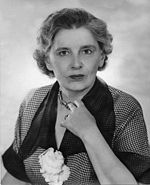
Rebecca West
1892-1983
Portrait by
| Rebecca West is the pen-name of Cicely Isabel Fairfield (1892-1983). Born in Co.Kerry, she was through her journalist father Charles Fairfield a descendant of George Rowan and Mary Blennerhassett (daughter of Thomas Blennerhassett, steward of Trinity College Dublin's Munster estates).
A great writer, author of numerous books and essays, she was one of the first female professional journalists, given the approbation of Irish socialist and fellow Fabian George Bernard Shaw (1856-1950) who said she could "...handle a pen as brilliantly as I ever could and more savagely...".
She was an intellectual and social rebel, joining the newspaper "Freewoman" in 1911 and having a seminal influence on the feminist movement. Her first published book was "Henry James" in 1916. She reported on the Nuremberg War Crimes Trials 1945-46.
Expressing great interest in history and genealogy, she proudly alluded to her "Kerry Cousins", namely Blennerhassetts, Crosbies and Dennys who were leading gentry of that county, so came under criticism from some feminist and socialist quarters as to why she should waste time on her ancestry...
She is referred to in the guise of Biddy Doran, and in phrases such as 'rebecca or worse' in the "Anna Livia Plurabelle" chapter of "Finnegans Wake" , as supposed revenge by James Joyce.
She enjoyed a long lasting friendship with H.G.Wells (1866-1946) and by him had a son, Anthony West (1919-1987), with whom Wells had an ambivalent relationship. Anthony published a biography of his father, "H.G.Wells: Aspects of a Life". Rebecca was used by Wells in his novels, as she also used real people in hers. She did later express some regret about meeting Wells, feeling the circumstances prevented her being married to another man.
In his novel "Tono Bungay", which also includes what appears to be a far-sighted warning of the dangers of nuclear waste, H.G.Wells mentions "Sir Roderick Blenderhasset Impey, some sort of governor or such-like portent in the East Indies" , who may perhaps have been based on Sir Arthur Blennerhassett Voules (1870-1954), senior British civil servant in Malaya and Resident Councillor at Penang, whose family had extensive interests in the rubber industry. |
|
|
|
|
|
Sources: (1) "Rebecca West, A life" by Victoria Glendinning, 1987.
(2) "Rebecca West: a Saga of the Century" by Carl Rollyson, 1995.
(3) "H.G.Wells: Aspects of a Life" by Anthony West, 1984.
(4) "Finnigans Wake" by James Joyce, 1939.
(5) "Tono Bungay" by H.G.Wells, 1909. |
|
|
|
|
|
LORD ACTON |
|
|
|
|
Lord John Acton
1834-1902
portrait by
National Portrait Gallery, London
|
John Dalburg-Acton, 1st Baron Acton (b.1834 d.1902) was the outstanding English Catholic historian and influential philosopher of freedom.
One of his ablest pupils was Charlotte von Leyden (b.1843 d.1917) only daughter of Count von Leyden of Bavaria who was closely associated with the Arco-Valley family, also relatives of Acton’s wife. In 1870 Charlotte had married Acton's friend Sir Rowland Blennerhassett MP, 4th Baronet of Blennerville in Co.Kerry (b.1839 d.1909). As Lady Blennerhassett she was invited to contributed two chapters, "The Doctrinaires" and "The Papacy and the Catholic Church", for vol.10 of the "Cambridge Modern History", edited by Acton.
Acton was Regius Professor of History at Cambridge, and when he nominated Sir Rowland Blennerhassett to succeed him was faced with opposition from John Morley (later Lord Morley) the Liberal politician and writer, who would not agree to Acton’s nominee. Acton wished to bequeath his extensive library of 70,000 books to the University of Cambridge and Morley was in the position of arbiter for the acceptance or non-acceptance of Acton’s bequest, so as a result held the whip hand over the appointment. Acton was obliged to accept the nomination of Morley's candidate, the professorial chair going to classical scholar J.B.Bury (1861-1927) of Trinity College, Dublin. Acton admired Bury's work and, as this appointment ensured his library found a home at Cambridge, was not too disappointed re the failure of his own nominee.
Lady Charlotte Blennerhassett was a litterateur, writing in German, French and English on history, politics and religion. Her published work includes "Madam de Stael", "Talleyrand", "Marie-Antoinette", "Chateaubriand", "John Henry Cardinal Newman", "Marie Stuart", "Louis XIV and Madame de Maintenon" and "Sidelights". In 1899 she received an honorary doctorate from the philosophy faculty at Munich in recognition of her labours in German, French and English literature. She was awarded the Golden Palm from the French Government for her research into French literature. She contributed to the Edinburgh Review and wrote a memorable tribute to Lord Acton.
Lord Acton, Sir Rowland Blennerhassett and Charlotte Blennerhassett were all liberal Catholics opposed to the Ultamontane doctrines of the contemporary Pope Pius IX, as was their mentor Professor Ignaez von Dollinger (1799-1890), an outspoken German priest and historian. When Acton began his study with Dollinger he had been captivated by Thomas Babington Macaulay, the eloquent Whig historian who championed liberty and human progress. Acton described himself then as “a raw English schoolboy, primed to the brim with Whig politics”, but Dollinger cured Acton of Macaulay, the young man becoming a fan of Edmund Burke (1729-1797) who early on had opposed the French Revolution. While with Dollinger, Acton attended lectures by the great German historian Leopold von Ranke (1795-1886) who stressed that the role of an historian was to explain the past, not to judge it. Rowland Blennerhassett had known Dollinger since 1864.
Lord Acton lamented and confided to Lady Charlotte Blennerhassett that “I am absolutely alone in my essential ethical position”. “Let me try as briefly as possible and without argument to tell you what is in fact a very simple, obvious, and not interesting story. It is the story of a man who started in life believing himself a sincere Catholic and a sincere Liberal; who therefore renounced everything in Catholicism which was not compatible with liberty, and everything in Politics which was not compatible with Catholicity. . . . Therefore I was among those who think less of what is than what ought to be, who sacrifice the real to the ideal, interest to duty, authority to morality”.
Dollinger and Acton had become outspoken critics of what they perceived as Catholic intolerance. Their contemporary targets were the Ultramontanes who sought to suppress intellectual freedom. Dollinger and Acton took issue with Vatican policy, especially after Pope Pius IX issued his notorious Syllabus of Errors (1864), which condemned alleged heresies of classical liberalism, including the scandalous idea that “The Roman Pontiff can and ought to reconcile himself to, and agree with, progress, liberalism and recent civilization”.
Acton contributed to a succession of Catholic journals whose mission was to help liberalize the Church: the bimonthly "Rambler" (1858-1862), quarterly "Home and Foreign Review" (1862-1864), and weekly "Chronicle" (1867-1868). These efforts were defeated in 1870 when the Vatican Council declared that the Pope was an infallible authority on Church dogma. Because Dollinger was a priest, his refusal to submit resulted in excommunication. Dollinger did not regard his excommunication as legal under Canon Law and certainly (under his opinion) did not eject him from the Catholic Church. Acton, a layman, wasn’t required to officially acknowledge the Vatican Council decrees, and he remained within the Church.
It was during this period that Acton wrote one of his most prophetic essays, “Nationality” (1862), which offered an early warning about totalitarianism: “Whenever a single definite object is made the supreme end of the State, be it the advantage of a class, the safety or the power of a country, the greatest happiness of the greatest number, or the support of any speculative idea, the State becomes for the time inevitably absolute. Liberty alone demands for its realisation the limitation of the public authority, for liberty is the only object which benefits all alike, and provokes no sincere opposition”.
Victorian confidence and progress saw the full horrors of totalitarianism. In time there was good reason to recall what Acton had once written to the Anglican apologist of the Borgia popes, Bishop Mandell Creighton: "Power tends to corrupt, and absolute power corrupts absolutely". This lesson was aimed at Acton’s liberal contemporaries, many of whom were inclined to make allowances for historical figures by citing their stage of historical development, but it had special relevance to the political developments of the twentieth century. In this respect Acton’s prescient views were to be largely vindicated during the lead up and aftermath of two world wars, in which abuses of nationalism and totalitarianism played their part.
Sir Rowland Blennerhassett had a strong interest and involvement in education, particularly in Ireland, and his connections with Germany enabled him to see the superiority of Germany's technical education structure and industrial efficiency, he publically expressing concern re: the inadequacy of Britain in comparison. |
|
|
|
|
|
Sources: (1) "Lord Acton and His Times" by David Matthew, 1968.
(2) "Acton and History" by Owen Chadwick, 1998.
(3) "The Catholic Who's Who Year Book" 1908.
|
|
|
|
|
|
| |
|
|